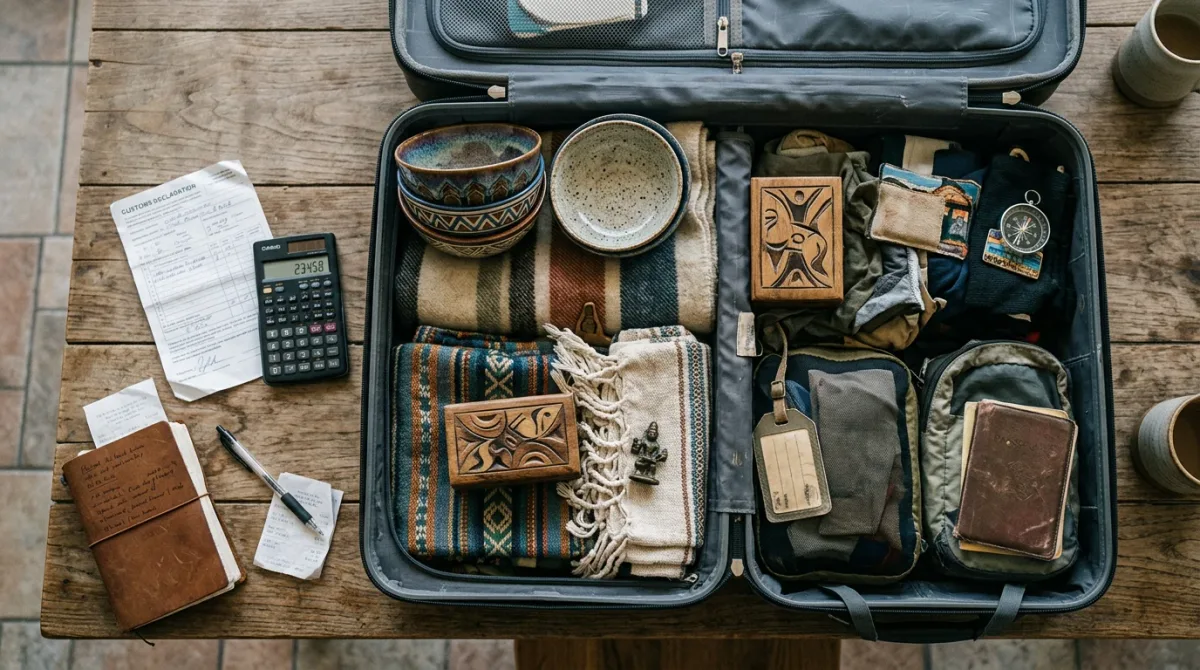
Most US residents flying home from abroad can bring back up to $800 in purchases duty-free, and that covers the vast majority of souvenir shopping — ceramics, textiles, jewelry, electronics. Go over it and you generally owe a flat 3% on the next $1,000, not the item-by-item tariff rate. The catch: you must declare everything, and the exemption resets only once every 30 days.
This isn't a legal ruling on your specific import — it's a plain-language walk-through of the public rule, sourced from US Customs and Border Protection and the federal regulation behind it. If your situation is unusual (a shipped item, a business purchase, a restricted material like ivory or certain leathers), CBP's own guidance is the place to check before you buy, not after you land.
What Is the Duty-Free Exemption, and How Much Is It?
CBP sets three exemption tiers depending on where you traveled, according to its official traveler guidance. The standard exemption is $800 for returning residents from most countries, covering the Caribbean Basin and Andean nations as well. Travelers returning from certain US insular possessions — the US Virgin Islands, American Samoa, Guam — can claim $1,600 instead. And if you don't qualify for either — because you've made more than one trip abroad in the past 30 days, or you were out of the country less than 48 hours — you fall back to a $200 exemption.
That $200 tier matters more than shoppers expect: it's an all-or-nothing threshold. Go one dollar over it and CBP can assess duty on the entire lot, not just the excess, per CBP's exemption guidance. Family members traveling together also cannot pool their individual $200 exemptions — each person's $200 stands alone. The $800 and $1,600 exemptions don't have that all-or-nothing trap; you're taxed only on the amount above the line.
How Much Duty Will You Pay Above the Exemption?
Once you clear your exemption, CBP applies a flat personal-use rate rather than looking up the tariff classification for every souvenir in your bag. Under the federal regulation governing personal declarations, goods valued up to $1,000 above your exemption are dutiable at a flat 3% rate, in place of the item-specific duty rate that would otherwise apply, according to the Cornell Law School's published text of 19 CFR § 148.101. Above that additional $1,000, CBP moves to the regular, item-specific tariff schedule — which is where a rug, a leather jacket, or electronics can carry sharply different rates from each other.
Alcohol has its own carve-out inside the exemption math. Under the $800 exemption, CBP's guidance allows up to two liters of alcohol duty-free if at least one liter was produced in a beneficiary country; the $1,600 exemption for insular possessions allows up to five liters under stricter sourcing conditions, with additional alcohol dutiable at a flat 1.5% rate plus applicable federal excise tax. The $200 exemption's alcohol allowance is far smaller — CBP lists it alongside 50 cigarettes and 10 cigars as part of that tier's fixed personal allowance.
What Should You Watch For Before You Land?
Declare first, sort out value second. CBP's return guidance is explicit that undeclared merchandise risks forfeiture — the item, not just the duty, is what's at stake if you skip the form. Every returning traveler completes a CBP Declaration (Form 6059B), either on paper, through a Global Entry kiosk, or through Mobile Passport Control; itemize what you bought and keep receipts, since a CBP officer calculates duty off the value you declare.
Watch the 30-day reset. If you use even a small part of your exemption on one trip — CBP's own example is bringing back $150 from a short trip to England — you don't get a fresh $800 exemption on a second trip inside 30 days; you're capped at what's left, or drop to the $200 tier if you've made multiple trips. Frequent cross-border shoppers, not just long-haul travelers, are the ones who get caught by this.
Some goods sit outside the exemption math entirely regardless of value — original fine art is one example CBP calls out as not counting toward the $800 limit — while others, unrelated to customs duty, are restricted or banned outright (certain wildlife products, some agricultural goods) and need separate research before you buy, not at the counter.
Price Reality: What the Exemption Actually Covers
| Exemption tier | Who it applies to | Alcohol allowance | Key limit |
|---|---|---|---|
| $800 | Most returning travelers from most countries (2026-08-20, per CBP) | Up to 2 liters, conditions apply | Taxed only on amount above $800 |
| $1,600 | Travelers returning from US Virgin Islands, American Samoa, Guam | Up to 5 liters, conditions apply | Taxed only on amount above $1,600 |
| $200 | Multiple trips in 30 days, or under 48 hours abroad | 50 cigarettes, 10 cigars, 150ml alcohol or perfume | All-or-nothing: exceeding it makes the full amount dutiable |
Flat-rate duty above any exemption: 3% on the next $1,000 of value, per 19 CFR § 148.101 (rate current as of 2026-08-20; the regulation shows this rate has been adjusted before and should be reconfirmed for high-value purchases).
For a related guides perspective, read How Much Can You Bring Back From Shopping Abroad Before US Customs Charges Duty?.