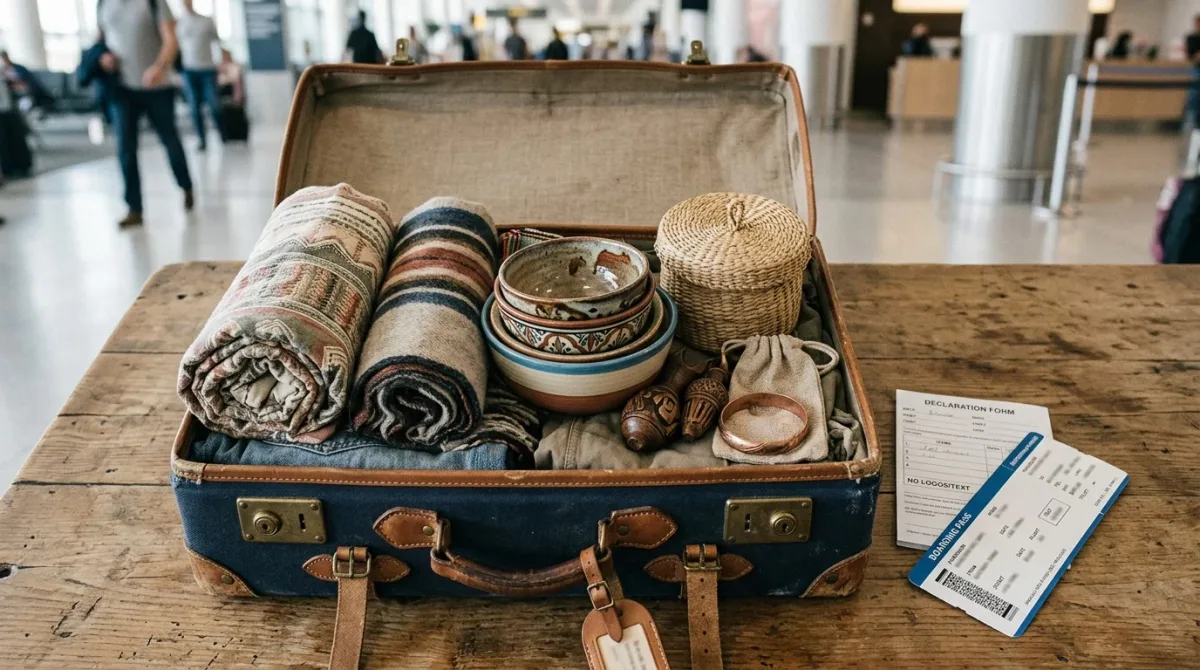
Most U.S. residents can bring home up to $800 in market purchases — rugs, ceramics, jewelry, textiles — without paying a cent in duty, as of August 20, 2026. Go over that, and U.S. Customs and Border Protection (CBP) doesn't just tax the overage: the entire dutiable amount can become taxable. Know the number before you haggle.
What counts toward your $800 exemption?
The $800 figure is the personal exemption CBP grants most returning U.S. citizens and permanent residents, according to CBP's official guidance on personal exemptions. It covers goods bought abroad for your own use or as gifts, as long as they travel home in your baggage or on your person — not shipped separately. That means the ceramic tagines from a Marrakech souk, the hand-loomed scarves from a Jaipur bazaar, or the leather goods from an Istanbul bazaar stall all count toward the same running total, added up at fair retail value, not what you haggled it down to.
You get the $800 exemption once every 30 days, per CBP. Use it on one trip and you can't claim it again on a second trip inside that window — you drop to the lower $200 exemption instead. CBP also requires that you've been outside the country at least 48 hours to qualify for the full $800; shorter trips (with some exceptions for travel to Mexico) cap you at $200, per the same guidance.
How much duty do you pay above $800?
This is the part shoppers get wrong: going over the exemption doesn't mean you owe duty only on the amount above $800. CBP's guidance on personal exemptions states plainly that once any item is subject to duty or tax, the entire dutiable amount becomes taxable — not just the overage. A traveler who comes home with $950 in market goods isn't taxed on $150; the whole $950 can be assessed. Budget-minded shoppers who are close to the line should keep receipts and know the running total before they hit the airport, not after.
CBP's guidance flags one narrow carve-out worth knowing: fine art is duty-free, regardless of value. That exemption is specific to fine art as CBP defines it — it isn't a blanket pass for anything described as “handmade” or “artisan.” A hand-knotted rug or hand-thrown pot is a market good subject to the normal exemption math, not fine art, unless CBP's own criteria say otherwise.
Does the exemption change depending on where you shopped?
Yes. The standard $800 exemption applies when you're arriving from most countries. Travelers returning directly or indirectly from a U.S. insular possession — the U.S. Virgin Islands, American Samoa, or Guam — get a larger $1,600 exemption instead, per CBP's exemption guidance. If your trip mixed a U.S. territory with a foreign country, the combined exemption and the accounting rules get more specific, and CBP's guidance is the source to check before you fly, not a market stallholder's assurance that “everyone brings this much home.”
What about the new rule on shipped packages?
Don't confuse the traveler's $800 exemption with a separate rule change that hit low-value shipments. Reporting from Fodor's notes that a 2025 executive order eliminated the longstanding $800 de minimis exemption that had let foreign retailers ship goods to U.S. buyers duty-free, with the change taking effect August 29. That shift applies to packages mailed or couriered from an overseas retailer — not to what you personally carry home in your suitcase. If a vendor at the market offers to ship your purchase separately to save on baggage weight, that shipment now falls under different, less forgiving rules than the exemption in your bag: Fodor's reporting cites a $200 daily duty-free cap on self-shipped personal purchases, with a $100 per-item ceiling within it. Carrying goods home yourself, inside the $800 personal exemption, remains the more predictable path for a market purchase.
What to watch for at the market and at the border
The exemption math is only half the picture. Before you buy:
- Keep the receipt, and note the price in the local currency plus the date of purchase — CBP can ask for proof of value, and a fair retail estimate without paperwork invites more scrutiny, not less.
- Track your running total in dollars as you shop across a multi-stop trip, especially if several purchases in different cities could push you past $800 in aggregate.
- Ask whether an item is restricted before you buy it — ivory, certain animal skins, and some plant materials carry separate import bans that have nothing to do with the dollar exemption.
- If a seller offers to ship your purchase home separately, get the shipping terms in writing; it changes which duty rule applies, per the shift in de minimis treatment for shipped goods.
For a related guides perspective, read How Much Can You Bring Back From Shopping Abroad Before US Customs Charges Duty?.