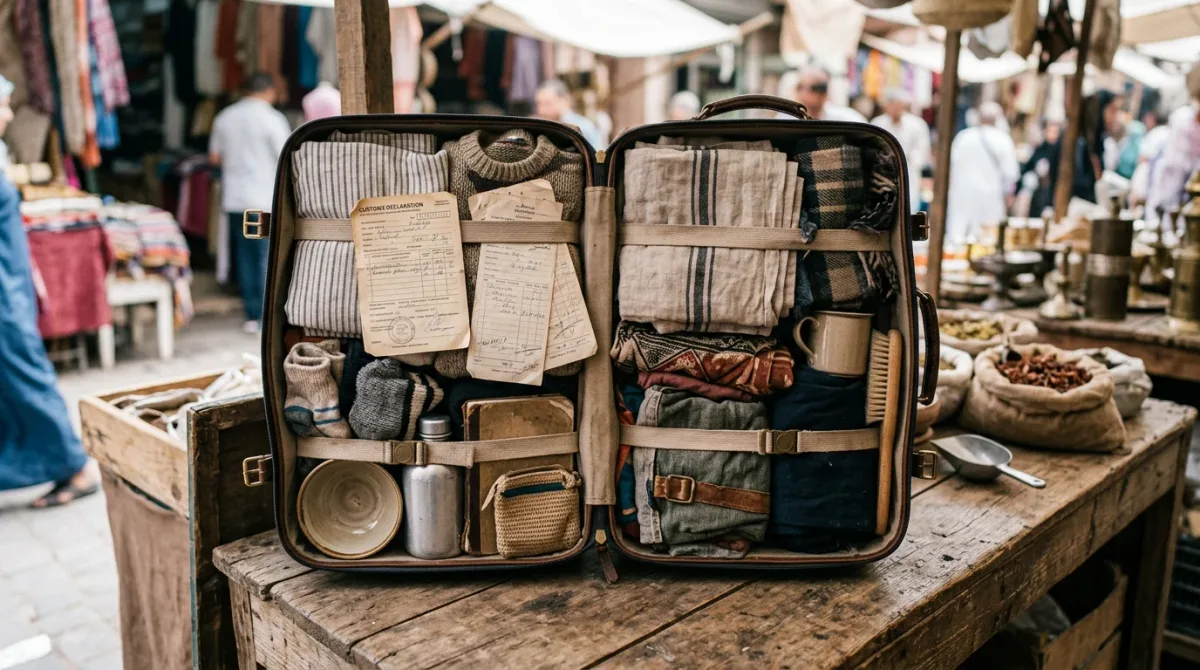
You can bring home $800 worth of goods per person, duty-free, once every 30 days — no paperwork beyond declaring what you bought (U.S. Customs and Border Protection, checked Aug. 20, 2026). Go over that and CBP charges a flat 3% rate on the next $1,000 in value, then standard tariff rates above that. Ship the same souvenirs home separately instead of carrying them, and a different rule applies: as of Aug. 29, 2026, low-value packages mailed from abroad lose the exemption that used to let them enter duty-free.
Shoppers conflate these two rules constantly, and the gap between them is exactly where people either overpay or get an unwelcome bill weeks after they're home. Here's what actually applies to a market or shopping-district trip, and where the numbers come from.
How much can you bring back duty-free?
The baseline personal exemption is $800 per returning U.S. resident, usable once every 30 days, according to CBP's "What to Expect When You Return" guidance: "You have not used all of your exemption allowance, or used any part of it, in the past 30 days" (CBP, checked Aug. 20, 2026). Two lower and higher tiers apply depending on where you traveled and how long you were gone, per CBP's "Types of Exemptions" page (checked Aug. 20, 2026):
| Exemption | When it applies | Alcohol included |
|---|---|---|
| $200 | Multiple trips within 30 days, or fewer than 48 hours abroad | Limited, personal/household use only |
| $800 | Most international travel, plus Caribbean Basin and Andean countries | Up to 2 liters, one must be from a listed country |
| $1,600 | Returning from U.S. insular possessions (U.S. Virgin Islands, American Samoa, Guam) | Up to 5 liters, with sourcing conditions |
CBP is explicit that family members cannot pool the smallest tier: "family members may not combine their individual $200 exemptions" (CBP, checked Aug. 20, 2026). CBP's public guidance does not spell out combination rules for the $800 or $1,600 tiers in the pages checked for this article, so don't assume you can stack a spouse's or child's allowance onto yours without confirming with a CBP officer or the CBP attaché at the relevant embassy — the "What to Expect When You Return" page directs unresolved duty-rate questions there (CBP, checked Aug. 20, 2026).
What happens once you go over $800?
You don't lose the whole exemption — CBP applies a flat rate on the overage instead of the full tariff schedule. Under 19 CFR § 148.101, goods for personal use accompanying a returning resident, valued up to $1,000 above the exemption, get a flat duty rate rather than item-by-item tariff classification; that flat rate has stood at 3% since Jan. 1, 2002, per the same regulation (Cornell Law School's Legal Information Institute, checked Aug. 20, 2026). So on a $1,500 haul with an $800 exemption, expect roughly 3% on the next $700 — call it about $21 — before any higher rate kicks in on value beyond the flat-rate ceiling. CBP's own return-processing page confirms the mechanism in plain terms: "the CBP officer will calculate the duties to pay on your newly acquired goods" once you're over the exemption (CBP, checked Aug. 20, 2026).
The number that matters here isn't the sticker price at the stall — it's what you declare. CBP is blunt about the consequence of skipping that step: "If you do not declare something that should have been declared, you risk forfeiting the item" (CBP, checked Aug. 20, 2026). Keep receipts. A vendor's verbal price isn't a customs value; what you actually paid is.
Does shipping your purchases home change the math?
Yes — and this is the part that just changed. Carrying goods in your luggage still falls under the $800 personal exemption described above, unaffected by anything else happening in trade policy. But mailing or shipping purchases separately used to fall under a different rule entirely: the "de minimis" exemption, which let low-value packages enter the U.S. without duty regardless of who sent them. As of Aug. 29, 2026, that shipment-based exemption ends for inbound international packages under the administration's order, according to Fodor's (checked Aug. 20, 2026). The traveler exemption itself is not changing: Fodor's reporting is explicit that the $800 personal allowance "is not ending on August 29" (Fodor's, checked Aug. 20, 2026).
Practically: if a market vendor offers to ship a rug or a set of ceramics home for you because it's too bulky to carry, ask who's technically the importer of record and expect duty to apply on arrival — that shipment no longer gets a free pass just because it's low-value. Carrying it yourself and declaring it at $800 or under stays duty-free.
What should you actually do at the market?
Track your running total in whatever currency you're paying, and convert it mentally to dollars as you go — not at the airport when it's too late to decide. If you're near the $800 line, decide before you buy the next item: is it worth roughly 3 cents on the dollar in duty for what's over your exemption? Usually yes for something with real value; sometimes not for a marginal souvenir. Keep every receipt in one place — a phone photo works — because CBP calculates duty off what you paid, and an official record beats your memory or a vendor's claim.
None of this is legal advice on your specific customs situation; CBP's own guidance is the authority, and its page directs unresolved cases to a CBP officer or the relevant embassy attaché (CBP, checked Aug. 20, 2026). But knowing the mechanism — $800 baseline, 3% flat rate on the next $1,000, and the fact that shipping no longer gets the shortcut it used to — is enough to shop a market without a customs surprise waiting at home.
For a related districts perspective, read What the $800 Duty-Free Exemption Actually Covers When You Fly Home With Shopping.