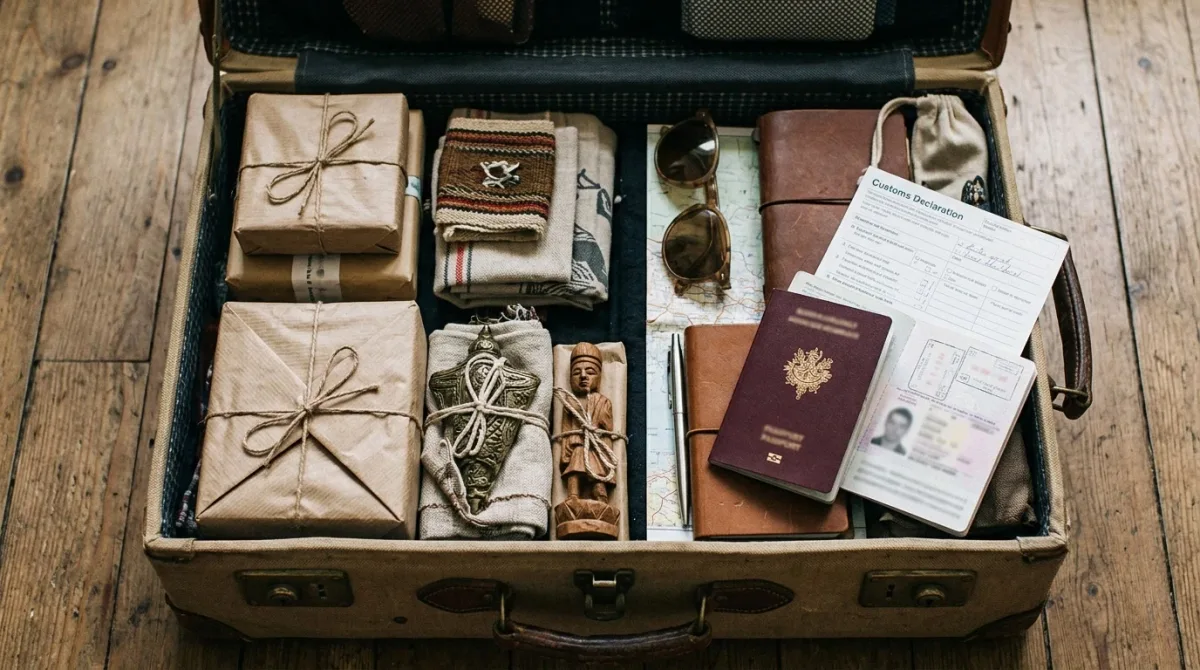
Bring home up to $800 in purchases duty-free from most countries, as of August 20, 2026 — carry it in your luggage, not the mail. Ship the same items instead and a separate duty now applies on arrival, since the $800 exemption for mailed and courier packages ended June 24, 2026. Declare everything; the form takes two minutes.
How much can you bring home duty-free?
U.S. Customs and Border Protection sets the personal exemption by where you traveled and how long you were gone, not by what you bought. CBP's exemption guide lays out three tiers, current as of August 20, 2026:
| Exemption | Who qualifies | Alcohol allowance |
|---|---|---|
| $200 | Trips under 48 hours, or any traveler who already used an exemption in the past 30 days | Not itemized separately by CBP |
| $800 | Most international trips, including the Caribbean Basin and Andean countries | 2 liters, with at least one liter produced in the region visited |
| $1,600 | Trips to or through U.S. insular possessions (U.S. Virgin Islands, Guam, American Samoa) | Up to 5 liters, with conditions on where they were purchased |
The $200 tier has one hard rule worth knowing before you shop: family members traveling together cannot pool their individual $200 exemptions into a bigger household total. You also can't claim a full exemption twice in 30 days — if you used any part of it on a trip last month, CBP requires a 30-day wait before the next one resets.
What if you ship purchases home instead of carrying them?
This is where the rules changed. Through June 2026, low-value packages mailed or couriered into the U.S. could enter duty-free under the $800 "de minimis" exemption — the same dollar figure as the traveler exemption, but a different legal provision. The Federal Register notice suspending that exemption, effective June 24, 2026, ends duty-free entry for shipments moving through "all modes other than the international postal network," including express consignment and parcel carriers. The notice is explicit that personal baggage is not what changed: bona-fide gifts valued at $100 or less and personal items of $200 or less carried by an arriving traveler "remain unchanged."
In practice, that means a rug or leather jacket you check as luggage still falls under the $800 (or $200, or $1,600) traveler exemption above. The same item shipped home from the shop instead now typically arrives with duty already built into the price, or held by CBP until duty is paid — Fodor's reported that overseas retailers are adjusting checkout prices or leaving the duty for the buyer to settle on delivery. Travelers who want to self-ship purchases can still move up to $200 worth per day duty-free, capped at $100 per individual item — but that route doesn't carry the VAT refund some shops offer on items you export in person.
How do you actually declare what you bought?
CBP's process is a form, not an interrogation. Steps, per CBP's traveler guidance:
- Keep receipts for everything you're bringing back, including gifts and anything you're not sure counts.
- Fill out a CBP Declaration — paper Form 6059B, or the equivalent prompts at a Global Entry or Automated Passport Control kiosk — itemizing purchased merchandise and any agricultural products.
- Declare the full value, not just the amount over your exemption; CBP calculates what, if anything, you owe on the excess.
- Pay any duty owed at that point — CBP officers handle the calculation at primary or secondary inspection.
Under-declaring is the actual risk here, not the paperwork itself. CBP determines the applicable duty on goods above your exemption at inspection, and for extra alcohol specifically, additional bottles above the exemption face a flat 1.5% duty rate plus applicable Internal Revenue Service taxes.
Price reality, checked August 20, 2026
- Personal duty-free exemption: $200 / $800 / $1,600 depending on trip origin and length — CBP, current as of this writing.
- De minimis exemption for shipped packages (non-postal modes): suspended since June 24, 2026 — Federal Register.
- Self-shipping allowance if you mail your own purchases: up to $200/day, $100 max per item — Fodor's, citing CBP guidance.
- Comparison basis: figures above apply to accompanied baggage of a returning U.S. traveler: gifts and commercial shipments follow separate, smaller thresholds.
Frequently asked questions
Does the $800 exemption reset every trip?
Yes, once 30 days have passed since you last used any portion of it. Traveling again inside that window drops you to the $200 tier.
Can my family combine our exemptions to cover one expensive item?
CBP's own guidance says no for the $200 exemption — each traveler's allowance is individual and can't be pooled.
Does the de minimis change affect what I pack in my suitcase?
No. The suspension that took effect June 24, 2026 applies to merchandise shipped or couriered into the U.S., not to personal baggage you carry through customs yourself.
What happens if I go over my exemption?
You still declare the full value. CBP calculates duty on the amount above your exemption at inspection; extra alcohol above the allowance carries a flat 1.5% rate plus IRS tax.
Is shipping purchases home still cheaper than paying an airline baggage fee?
Not automatically anymore. Since the shipping exemption ended, expect duty built into the price or collected on delivery — run the math against your airline's checked-bag fee before you decide.
For a related shopping news perspective, read Economic Benefits of a Sustainable Agricultural Revolution.