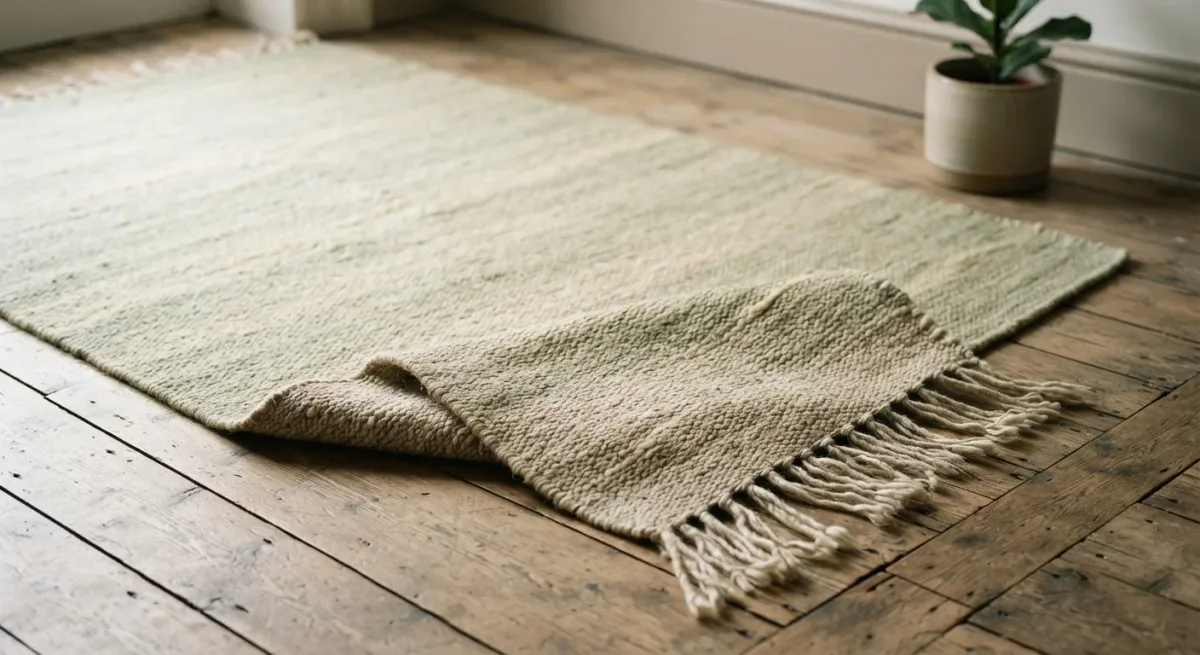
A hand-knotted rug is one woven knot at a time on a loom, and the knots, not the label, tell you what you're buying: flip the rug and look at the back, where the pattern shows through clearly on a hand-knotted piece and is absent on a machine-made one, per the guidance published by rug-trade bodies and museum textile departments. That one check separates the two categories in ten seconds. Everything after it — materials, density, dyes — separates the good examples from the ordinary ones.
This guide covers what to examine and why, without asserting authenticity for any individual piece; when in doubt, an independent appraisal before purchase is the reliable route. No prices are quoted because market prices move and vary by seller; the checks below don't.
What does the back of the rug tell you?
The back is the honest side. On a hand-knotted rug you'll see the individual knots as a fine grid, slightly irregular, with the design visible in mirror image, per textile-conservation guidance published by museum collections including the Textile Museum's care resources. Machine-made rugs show a uniform weave or a glued backing holding a pile in place — and that glue is why machine pieces can't be cleaned the way knotted rugs can.
Irregularity is evidence of the hand, not a defect. A perfectly regular grid on a supposedly hand-knotted piece is the thing that should slow you down.
How much does knot density matter?
More knots per square inch means more labor, finer detail, and usually a higher price — it does not mean a rug you'll like more, per trade guidance from rug-merchant associations. A coarse tribal weave at low density can be a better rug than a dense city weave if the wool is better. Density is a pricing factor; it is not a quality ranking across traditions.
Count what's in front of you: turn the rug over and count knots along one inch of the warp on the back, in two places. The count is your comparison tool between two rugs in the same shop, nothing more.
What should you check about the materials?
Wool, silk, and cotton are the traditional fibers, and each has look-alikes. Artificial silk — mercerized cotton or rayon — is sold as silk in some markets; trade bodies advise checking by taking a tiny fringe thread and, if the seller permits, burning a sample: wool smells like burnt hair and self-extinguishes; cellulose fibers burn like paper. Ask before you burn anything on someone's inventory.
Natural dyes age softly and unevenly; synthetic dyes are brighter and more uniform. Neither is fake — synthetics date to the late 19th century and appear in genuinely old rugs — but the difference affects value, per the dating guidance used by appraisers.
What are the honest caveats?
The fringe is part of the rug, not sewn on. On a hand-knotted piece the fringe is the warp threads the rug was woven on, per conservation guidance; a fringe glued or stitched onto a machine-made edge is a finishing detail. The 'handmade' label by itself covers a wide range — hand-tufted rugs are made with a tufting gun and a latex backing, involve real handwork, and are not knotted at all.
Old does not mean valuable, and valuable does not mean old. Export restrictions on antique textiles exist in several producing countries; ask for documentation on anything sold as antique, and verify your home country's import rules before you ship rather than after.
The strongest position you can hold at the point of sale: know the fiber, know the construction, know the count, and be willing to walk. A seller who won't let you examine the back of the rug has answered your most important question already.