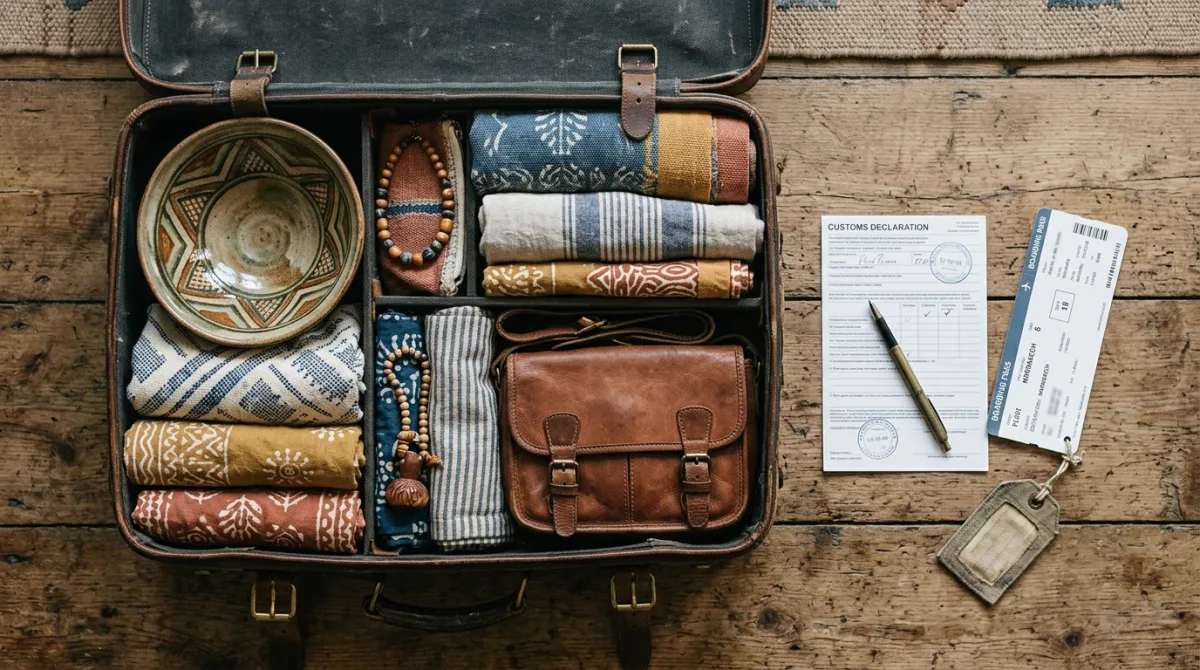
Returning U.S. residents can bring home up to $800 in goods bought abroad, duty-free, once every 30 days — the number is set in federal regulation, not by any airline or store sign. Go over it and the next $1,000 in value is taxed at a flat 3%, not your item's individual tariff rate. Families traveling together can pool their exemptions on one declaration.
That $800 figure sounds simple until you're standing at a stall with a rug in one hand and a receipt in the other, doing math in a currency you don't use at home. Here's what the rule actually says, sourced to the regulation itself, not to a departures-lounge rumor.
How much can you bring home duty-free?
Under 19 CFR 148.33(a), a returning resident may bring in articles for personal or household use, duty-free, up to an aggregate fair retail value of $800 in the country where they were acquired — provided the goods accompany the traveler and the exemption hasn't been used in the prior 30 days. Arrivals directly from a designated beneficiary country get the same $800 allowance, and it can apply even when the goods don't travel with the person. Travelers arriving from Guam, American Samoa, the Northern Mariana Islands, or the U.S. Virgin Islands get a larger $1,600 exemption, though only $800 of that can be goods acquired somewhere other than those territories.
The exemption covers “fair retail value in the country of acquisition” — what you paid, or what the item would sell for there, not a U.S. retail comparison. A carved wood bowl haggled down to $40 in a market stall counts as $40 toward the limit, not the $90 a boutique back home might charge for something similar.
What happens to the value above $800?
You don't lose the exemption by going over it — you just start owing duty on the excess. Per 19 CFR 148.101 and 148.102, the next $1,000 in fair retail value above your personal exemption is charged at a flat rate of 3%, a rule in effect since January 1, 2002, rather than the individual tariff classification each item would otherwise carry. Past that combined $1,800 in goods, standard duty rates apply item by item, which is where a customs broker or the CBP tariff schedule — not a market vendor's guess — becomes the only reliable source for what you'll actually owe.
Can a family combine exemptions?
Yes. Under 19 CFR 148.101, family members who live in the same household and return together can group their individual exemptions into a single family exemption on one customs declaration, regardless of who actually bought or is carrying which item. A couple traveling together effectively has $1,600 in combined duty-free room before the flat rate kicks in — useful to know before you split purchases across suitcases to “stay under the limit” per person, which isn't how the rule works.
Does the exemption reset every trip?
Not immediately. The regulation is explicit that the $800 exemption cannot be used more than once in a 30-day period, and any unused portion from one trip does not carry over or add to a later one. If you crossed back into the U.S. two weeks ago and used your exemption, a market haul today draws duty from dollar one, regardless of how little you actually spent.
Price-reality block
- Standard personal exemption: $800 per person, once every 30 days — 19 CFR 148.33, as of August 20, 2026
- Exemption from Guam, American Samoa, CNMI, or U.S. Virgin Islands: $1,600, with an $800 cap on goods from elsewhere — 19 CFR 148.33
- Flat duty rate above the exemption: 3% on the next $1,000 in fair retail value, in effect since January 1, 2002 — 19 CFR 148.101–148.102
- Value counted is fair retail value where the item was bought, not U.S. retail price — 19 CFR 148.33
What to watch for
The exemption is generous enough that most casual market shopping — ceramics, textiles, small leather goods, jewelry under a few hundred dollars — clears it without issue. Where travelers get caught out is bundling: a rug, a set of ceramics, and a leather jacket from the same trip can add up past $800 fast, and the fair-retail-value rule means undervaluing a purchase on the customs form is a declaration problem, not a savings strategy. Keep receipts. They're the only evidence a customs officer has to work with if your stated value gets questioned, and they're what separates an honest estimate from a costly one.
None of this is legal advice on an individual customs case — if a shipment, a high-value item, or an unusual entry point is involved, the fair-retail-value and duty-rate rules can interact in ways worth checking against a customs broker or U.S. Customs and Border Protection directly before you travel, not after you've already paid.
For a related retail perspective, read How the $800 Duty-Free Exemption Actually Works — and Why Shipping Your Souvenirs Home No Longer Does.