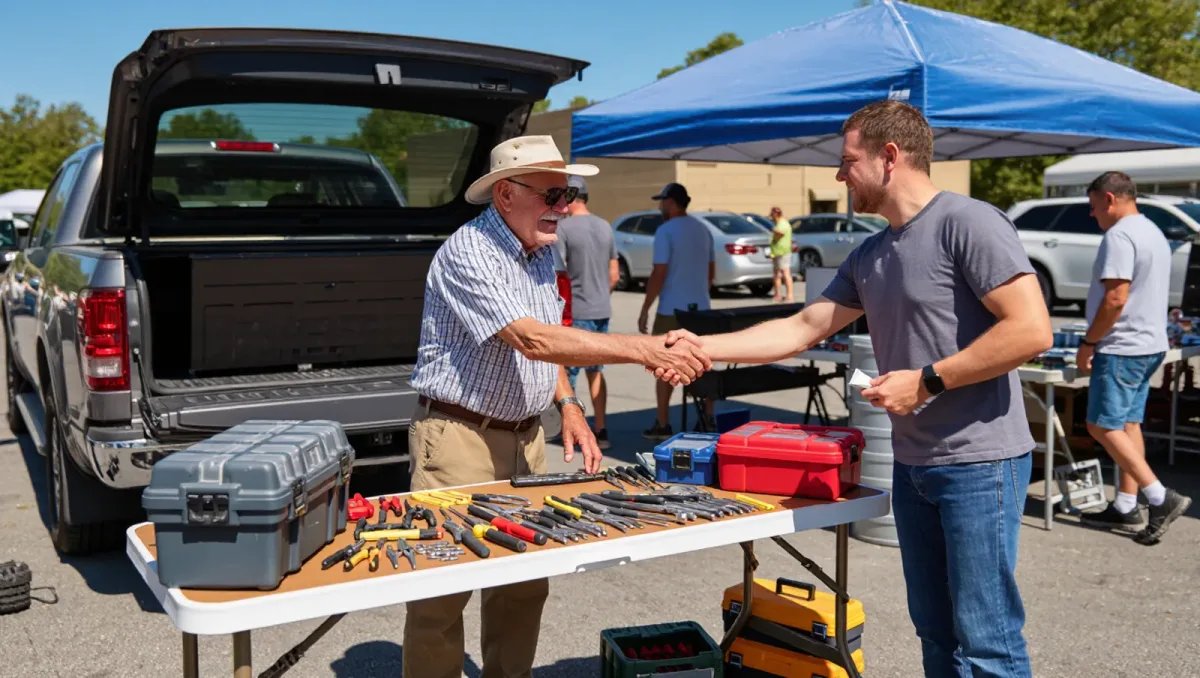
At American swap meets, prices move about 20–40% for a buyer who arrives in the final hour with cash in small bills: sellers discount rather than repack, checked June 2026 across major California and Texas markets. Opening offers of 50–60% of the ask are accepted practice on used goods; on new-in-package merchandise the discount range narrows to 10–20%. Everything else — politeness, bundling, and walking away once — is mechanics around those two facts.
Swap meets occupy a distinct niche: cheaper than antique shows, more negotiable than thrift stores, and far more social than online marketplaces. This guide covers how their pricing works and what to check before you buy.
What exactly is a swap meet?
A swap meet (the same institution as a flea market in most of the country) is a rented outdoor lot or fairground where vendors rent spaces by the day and sell everything from estate tools to socks by the case. Most are weekend operations; large ones, like the sprawling Southern California markets, run weekly with hundreds of sellers, checked June 2026. Admission usually costs $1–$5, some markets free after early afternoon, and parking is often the real cost.
When should you arrive — early or late?
- Early (first hour): best selection, full prices. Collectors and resellers arrive at opening and they pay asking. If you hunt specific collectibles, this is your hour, and it is not a bargaining hour.
- Middle of the day: normal haggling territory — 10–30% off with a pleasant, unhurried ask.
- Final 60–90 minutes: discount hour. Vendors calculate load-out costs against last sales; 20–40% off is routine, checked June 2026, and items that survived the day may be sold near cost.
How do you negotiate well?
- Cash in small bills, visible but not fanned. A vendor who sees exact twenties counts fewer risks than one promised a digital transfer. Most swap meet vendors are cash-first; card readers exist but are not universal, checked June 2026.
- Ask “what's your best price?” once. It is the standard American opener and it works. Then counter once. Repeated lowballing over a $10 item reads as disrespect for the seller's morning.
- Bundle. Two items for one-and-a-half prices is the deal every vendor accepts faster than a discount on one. Bundle two tables apart only after you have agreed both single prices.
- Walk away once, slowly. At a swap meet this works genuinely: the next table may have the same tool cheaper, and vendors know it. Walking twice reads as a game.
- Respect the line. Never negotiate over someone mid-transaction with the same seller; wait your turn. Swap meet culture is small-town rules at highway scale.
What should you check before paying?
- Power tools and electronics: ask to plug them in. Most vendors expect it and many bring extension cords for exactly this purpose. A seller who refuses a test on a corded tool has told you the price.
- Bicycle and tool brands: swap meets are where stolen-goods risk is real; heavily marked serial numbers or a trunk-load of identical new retail items deserve skepticism. Buy the categories you can evaluate.
- Counterfeit goods: designer logos at no-brand prices are counterfeit, and buying them is not a bargain, it is a violation. US Customs and Border Protection seizes counterfeit consumer goods in the tens of thousands of shipments yearly, per CBP trade statistics, checked June 2026. Skip them.
- “Returns” and second-run merchandise: new-in-box goods at deep discount are often customer returns or shelf-pulls; open the box before paying.
What sells well — and what to leave?
Swap meets are strongest on tools, garden equipment, vintage electronics, records, auto parts and furniture at prices a resale app cannot match once you factor the negotiation, checked June 2026. Leave the categories where authenticity matters and you cannot verify: brand-name cosmetics, phone accessories with logos, and anything safety-critical like helmets and child car seats, which may be expired or crash-damaged without visible signs.
The bottom line
Scout early, buy late, carry twenties, test before you pay, and treat every seller as a neighbor you will see next weekend — because at a swap meet, you will.