The best holiday markets are the ones you plan a day around, not a detour between errands. They run in the stretch that Americans call "the holidays" — the weeks from late November through New Year's, a period Wikipedia describes as containing many of the most important holidays in American culture. That window is short, the crowds are real, and the difference between a good visit and a frustrating one usually comes down to timing.
The short version: go early, go on a weekday, and go with a short list. Craft and food markets reward shoppers who arrive when stalls open, when vendors have full stock and the aisles are walkable. By early afternoon — especially on the two anchor dates of the season, Thanksgiving Day, which falls on Thursday, November 26 in 2026, and Christmas Day on Friday, December 25 — the crush builds fast. Plan around it and you will actually see the goods instead of the backs of other visitors' coats.
What counts as a holiday market?
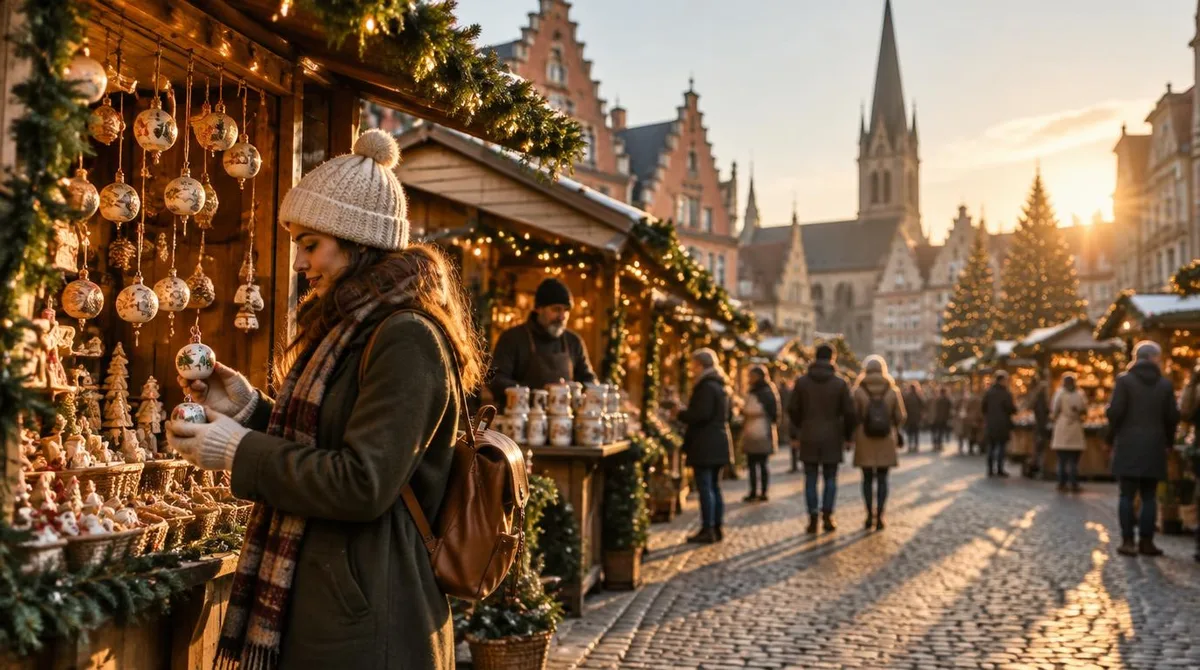
The term covers three different animals, and it helps to know which one you are heading to. First, the Christmas-style market: wooden stalls, mulled drinks, ornaments, handmade gifts, usually outdoors or in a covered square. Second, the indoor craft and food hall that puts on a seasonal program — extended hours, special vendors, gift stalls mixed in with the daily traders. Third, the one-off weekend market: a school gym, a fairground, a church hall, open for a few days only.
Each has a different rhythm. The permanent market with a seasonal overlay is the most forgiving — if Saturday is a mob scene, the same hall is quiet on a Tuesday morning. The one-off weekend market is the least forgiving: it only exists when it exists, and everyone in town knows it. For those, arrive at opening or accept the line.
The food side of these markets has deep roots. One small example: the spiced dried-fruit filling behind the mince pie traces back to a medieval preservation method for meat and fruit, according to National Today, which notes the filling evolved into a fixture of British Christmas baking. Markets are where that kind of food history stays visible — you can watch it being made, not just buy it wrapped.
When should you actually go?
Timing is the whole game, and it is simpler than it looks.
- Weekday mornings beat weekend afternoons, every time. Vendors restock overnight, so early stock is the full range. By mid-afternoon on a Saturday, the popular stalls are picked over and the aisles are slow.
- Go early in the season for selection, late for discounts. The first weekends have the widest choice. The final days before Christmas can bring price flexibility from vendors who would rather not pack stock home — but the good stuff is usually gone by then.
- Check the closing date, not just the opening one. Some markets run daily through the season; others pop up for single weekends. A market that closed last Saturday does not care that you drove an hour.
- Weather changes everything outdoors. A mild weekday draws a fraction of the crowd a sunny Saturday does. Cold and clear is often the quietest combination of all.
One more timing note: public holidays reshape the whole calendar around you. Federal holidays fall on set dates — Thanksgiving on the fourth Thursday of November, Christmas on December 25 — and, as Calendarr explains, when one lands on a weekend it is observed on the adjacent Friday or Monday, which turns some ordinary weekdays into days off. A market near an office district can be packed on an "observed" Monday that would otherwise be dead. Check the local holiday calendar before you pick your day.
What is actually worth buying?
Holiday markets sell three categories, and they are not equal.
Food and drink you will consume this season is the safest spend. Baked goods, preserves, spice blends, cheese, chocolate — these have a clear comparison basis: you know what the supermarket version costs, so you can judge whether the market version justifies its premium. Buy what you will eat within days, not souvenirs of the season.
Handmade goods from the person who made them are the reason to go at all. The honest caveat is the house rule: the stall that says "handmade" is not always the hands that made it. Ask a question — where was this made, how long does one take? A maker answers easily. A reseller deflects. Neither answer makes the goods bad; it just changes what a fair price is.
Mass-produced seasonal decor is where markets are weakest. If the same item is on a big retailer's website, you are paying a market premium for atmosphere. Sometimes that is worth it — you are there, it is cold, the item is charming. Just know what you are paying for.
Our analysis, across every market type we cover: the goods with no fixed retail comparison — one-off ceramics, small-batch food, direct-from-maker textiles — are where a market day earns its keep. Everything else you can price from your phone while standing in the aisle. For related coverage, see Otavalo Market Guide: What Ecuadorian Textiles Should Actually Cost.
How do you avoid the peak-hour crush?
Beyond picking the right day, a few habits change the experience.
- Set an arrival time, not a duration. "Be there at opening" beats "spend the afternoon." Two focused hours early beat four exhausted ones late.
- Walk the whole market once before buying anything. The first stall is rarely the best price. The last stall is rarely the best either — but you will only know if you look.
- Eat off-peak. Food queues peak between roughly noon and two. Eat at eleven or after three and you skip the longest lines in the place.
- Carry cash in small notes. Card readers fail in cold weather and crowded tents; vendors with a working reader in a dead zone will thank you for exact change.
- Have a meeting point. Phone batteries die fast in the cold, and every holiday market looks identical in every direction once you lose your group.
What about the markets themselves — big city or small town?
Both work, for different reasons. Big-city holiday markets offer range: dozens of vendors, food halls, extended hours, and the option to duck indoors when the weather turns. Small-town markets offer the opposite virtues: lower prices on the same categories, vendors who are actually the makers, and a pace that lets you talk to them. If your goal is gifts with a story, the small market often wins. If your goal is one-stop coverage of a long list, the city market does.
If you are shopping Europe's seasonal markets specifically, the price picture matters before you go — we break down what things actually cost at Europe's Christmas markets in a separate guide. And if your holiday shopping drifts toward secondhand rather than new, the same early-arrival logic applies; our guide to flea market finds and how to spot real value covers the evaluation side in detail.
What this means for your calendar
Plan the day, not just the trip. Pick a weekday, arrive at opening, walk the full market before you buy, and spend on the things you cannot price from a screen. The seasonal window is short and the crowds are predictable — which means both are avoidable. The shoppers who look relaxed at a holiday market in mid-December are not lucky. They went on a Tuesday morning, and they had a list.