The best small town shopping day comes down to three things: a main street you can walk end to end in twenty minutes, shops that are owned by people who live there, and prices that make sense once you look twice. If a downtown has all three, you do not need a ranking to tell you it is good. If it has none, no list will save your afternoon.
Worth saying up front: the word best is doing a lot of work in headlines like this one. According to The Free Dictionary, best is simply the superlative of good — it means surpassing all others in quality or suitability, which is only ever true relative to a comparison you can actually check. So treat any ranked list of downtowns, including the frameworks in this guide, as an opening offer rather than a verdict. The price tag is an opening offer too.
What follows is not a list of named towns, because a ranking you cannot verify is decoration. It is the checklist we use to separate a working main street from a stage set — and a few honest warnings about the stage sets.
What makes a small-town downtown worth the drive?
A good shopping town passes four quick tests, and you can run all of them before lunch.
- Ownership. Look for names on the door that match names on the till. Independent shops anchor a local economy because the money stays in it. A street of franchises with local paint colours is a mall wearing a costume.
- Vacancy pattern. Two or three empty units is normal turnover. A whole block of papered-over windows, or a street that is half vape shop and half souvenir, tells you the rent and the footfall stopped agreeing with each other.
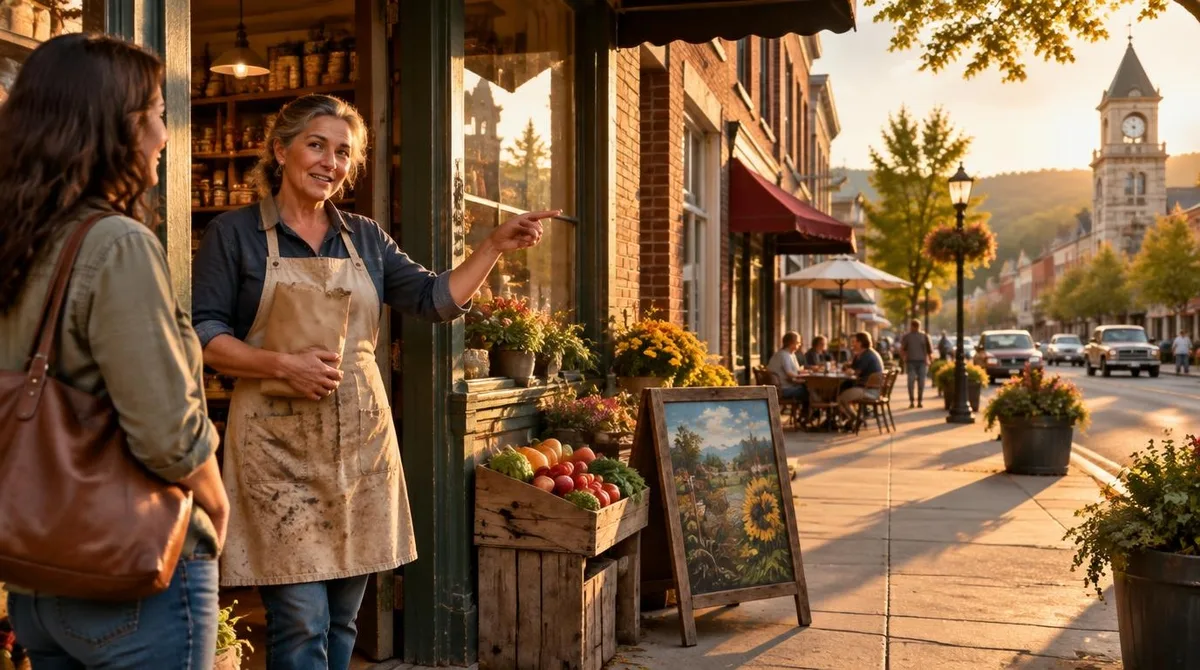
- Walkability. Parking once and walking is the whole point. If the 'downtown' is really four clusters separated by car parks, you are shopping a strip mall with better architecture.
- Working goods, not just gifts. A hardware shop, a bookshop, a grocer, a cobbler. Towns that keep their practical shops keep their shoppers the other eleven months of the year — and the prices are more honest there too.
Our analysis: the fourth test is the one most 'best towns' articles quietly skip, because gift shops photograph better than plumbers' merchants. But a main street that only sells things you could buy online is a theme park, and theme parks charge theme park prices.
How much should you actually spend on a day like this?
There is no sourced national figure for a small-town shopping day, so here is the price reality in the only honest form available: structure, not numbers.
- Food and drink is usually the biggest line. A bakery lunch and a coffee beat a tourist-restaurant menu on both price and quality, as a rule. The café with a queue of locals at noon is the one to join.
- Goods should be judged the way you would judge them anywhere: on materials and make, not on the word 'local' stitched onto them. A locally made item can be fairly priced or wildly overpriced; the label proves neither.
- The 'deal' check. Any claim that a town is 'cheaper than the city' needs a comparison basis. Cheaper on what, compared with which city, checked when? If nobody can answer, budget as if it is not cheaper. You are paying for the day out, and that is fine — just price it honestly.
One habit worth stealing: before you buy anything over a token amount, ask yourself the cost-per-use question. A hand-thrown mug used daily for five years is cheap. A decorative one used never is expensive at any price. The same test applies to textiles, leather and anything else a main street likes to sell you — and if you are looking at rugs specifically, the checks that matter are laid out in What to Check Before You Buy a Hand-Knotted Rug.
What to watch for: the stage-set downtown
Some small towns have learned to sell the idea of themselves, and the tells are consistent.
- The same stock in every window. Candles, branded home décor, imported 'artisan' goods with no maker named. If three shops carry identical inventory, a wholesaler is supplying the 'independents'.
- Prices with no origin story. A maker who is real can usually tell you where the thing was made and by whom in one sentence. Vagueness is a pricing strategy.
- Sale theatre. A permanent 'going out of business' banner, or a discount that has been on since you last visited two years ago, is not a discount. It is the price, with a costume on.
- Opening hours that exist for visitors only. If everything shuts at four on a weekday, the street is performing for weekend day-trippers. Fine to visit — just do not confuse it with a living high street.
None of this is an accusation against any particular shop or town. Genuine maker shops and wholesale-dressed gift shops sit on the same streets, sometimes next door to each other. The questions above sort them without anyone being insulted.
How do you plan a small-town shopping day that pays off?
A short process, because that is what this is.
- Check the calendar before the drive. A market day or a town festival changes everything — sometimes for better, sometimes just for crowds and closed car parks. Local council or chamber-of-commerce pages usually list them.
- Arrive before the coaches. On streets that run on day-tripper trade, the first two hours are calmer and the shopkeepers have time to actually talk. That conversation is where the good stuff gets found.
- Do one full lap before buying. Walk the street end to end, note two or three shops worth a return, then buy on the second pass. You will avoid the first-shop premium, which is a real thing even in towns of two thousand people.
- Ask one question per purchase: 'Who made this?' The answer either justifies the price or ends the conversation, and both outcomes save you money.
- Keep the receipts and know the return position. Independent shops are not all covered by the same return habits as chains. Ask before you pay, not after.
If your shopping day crosses a border — a trip to Canada, a run to a Mexican market town — the customs side is its own subject, and guessing at it is how people end up paying twice. Start with How Much Can You Bring Home Duty-Free From a Shopping Trip Abroad? and treat the official government portals as the final word, not a blog summary. This connects to our earlier piece, How Much Can You Bring Home Duty-Free From a Shopping Trip Abroad?.
Where the 'best' list goes from here
The evidence here supports a method, not a podium. A downtown earns the drive when the shops are locally owned, the practical trades have survived, and the prices survive one honest question. It fails when the same wholesale stock sits in every window and the discounts never end.
What remains unknown is the part no checklist can settle: which particular towns currently pass, which changes season by season and shop by shop. That is a reporting job, and it is done street by street with dates on every price — the way we cover it in our Shopping News section and our wider Guides coverage. Until a town has been walked and priced that way, treat every superlative — including the one in this headline — as the opening offer it is. As WordReference puts it in its entry on the word, best means most suitable or advantageous, and suitability is always judged against a purpose. Yours is the only one that counts.