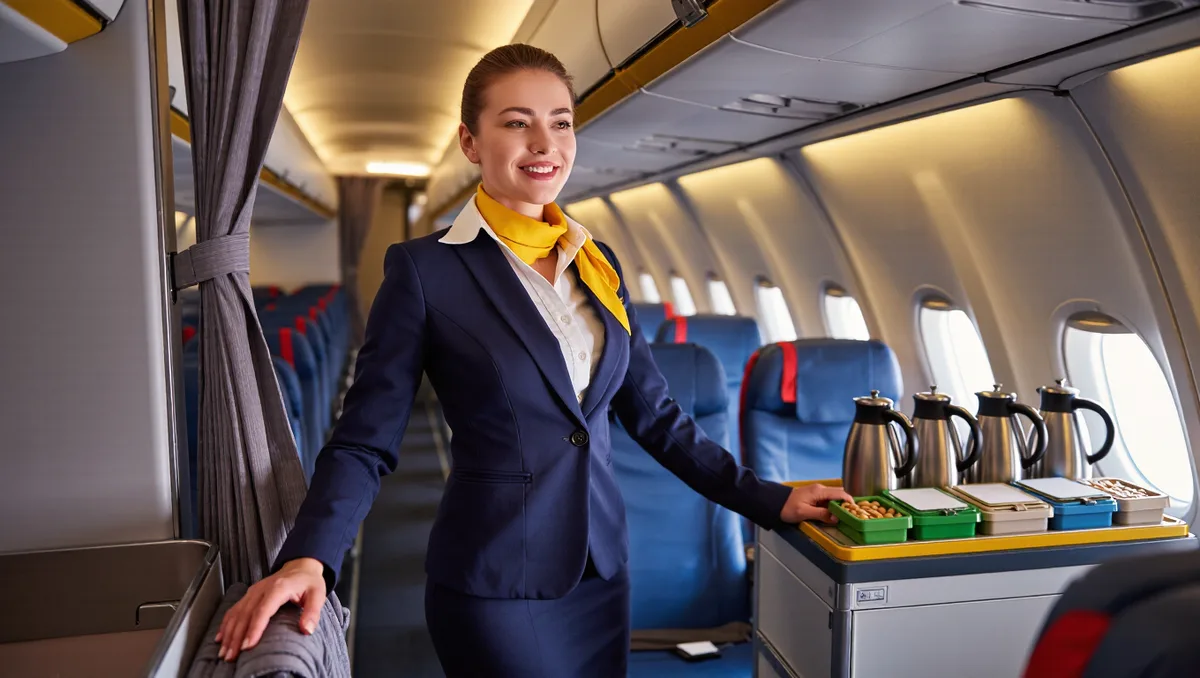
Ask a flight attendant what the job is really like, and the honest answer is that it is two jobs. One is service: meals, blankets, a calm voice at the galley curtain. The other is safety, and it is the one passengers rarely see. Crew are on board primarily to keep everyone alive if something goes wrong, and the beverage cart is almost incidental to that.
This piece looks at the rhythms of a long career in the aisle — the training, the long-haul days, the passengers who come back — drawn from what the role publicly requires and what crew themselves describe. It is written for travelers who want to understand the person standing in the aisle, not for anyone considering the career blind. The honest caveat comes early: much of the job is waiting, and the parts that are not waiting are governed by rules most passengers never think about.
One practical note before the main sections. If you are booking the flight your crew will work, timing matters more than most people assume. According to KAYAK, its data shows January is the cheapest month to fly domestically and February the cheapest internationally, while December is the most expensive month for international travel — a reminder that the cabin you board in was priced long before you chose it.
What does the training actually cover?
The public image of training is a smiling walk-through of the safety card. The real curriculum is narrower and harder. Crew train on evacuations, because getting a full cabin out on the ground in a short window is the single skill the role exists to deliver. They train on fire-fighting in the cabin, on decompression, on first aid, and on security procedures. They requalify regularly, so the classroom never fully goes away, even for veterans.
What surprises new crew is how much of the training is about people. Conflict de-escalation, recognizing a passenger who is unwell, and managing a cabin full of strangers under stress are all treated as safety skills, not soft ones. A crew member who cannot calm an argument at row 30 is not a service problem; they are a safety problem, because an agitated cabin is harder to manage if anything goes wrong later. Readers following this should also see What Buy Now, Pay Later Actually Costs — and Who Protects You If It Goes Wrong.
The other thing training teaches is humility about the aircraft itself. Crew learn that every type they work on behaves differently — doors, exits, galley equipment, even the phrasing of announcements. A veteran on one aircraft type is a learner again on the next. That cycle of relearning is one reason the job stays demanding after decades, not despite the routine but because of it.
What do long-haul days actually look like?
A long-haul duty is built around a strange clock. The flight departs late, the cabin dims, and most passengers sleep while the crew works in shifts. Someone is always awake in the aisle, and someone is always on the galley floor answering the call button. The work is quieter than a short-haul day but never stops, and the body keeps its own ledger of the disrupted nights.
Between services there are long stretches of low-level vigilance: walking the cabin, checking on sleeping passengers, watching for anyone who looks unwell. Crew describe this as the least visible part of the job — hours in which nothing happens, and in which their whole purpose is to notice if something starts to. The service moments, the meals and the drinks, punctuate that watch rather than define it.
Then there is the layover. It looks like a free night in an interesting city. In practice it is a regulated rest period with a report time attached, and the city is often seen from a hotel window. Crew who love the job tend to make peace with this: the destination is the work, not the stopover. Travelers who want to use a stopover properly — including what they can legally bring home from it — can start with our guide to duty-free allowances after a shopping trip abroad. We covered a connected angle in How Much Can You Bring Home Duty-Free From a Shopping Trip Abroad?.
How has the job changed over a long career?
The service side has slimmed. On many routes, what was once a full meal service is now a buy-on-board cart or a single tray, and crew spend less time serving and more time managing a cabin that boards fuller than it used to. Load factors rose across the industry for years, which means more passengers per flight and less slack for everyone, crew included.
The security side has grown. Since the early 2000s, crew have carried responsibilities in the cabin that earlier generations never trained for, and the training syllabus reflects it. The job's center of gravity has shifted accordingly: less about hospitality, more about managing a sealed environment with several hundred strangers in it.
What has not changed is the human core. Crew still meet people on the worst day of their trip — the missed connection, the fear of flying, the illness at 35,000 feet — and the job is, at its best, the calm presence in that moment. Veterans often say that is the part they would keep even if everything else changed again.
What do crew wish passengers knew?
First: the crew are not the airline's voice of refusal. When a request is declined, it is nearly always a rule, not a mood. Regulations on cabin baggage, seatbelt signs, and electronic devices are set well above the individual crew member, and arguing with the person in the aisle is arguing with a rulebook they did not write.
Second: the call button is not an inconvenience to the crew — it is their job. What frustrates them is not being needed; it is being spoken to as if service were servitude. The difference costs a passenger nothing and changes a flight for everyone nearby.
Third: the crew notice more than passengers think. They are trained to read a cabin — who is unwell, who is anxious, who has had too much — and they act on what they see quietly. The smoothness of an uneventful flight is not luck. It is the vigilance part of the job doing exactly what it was trained to do.
What this means for your next flight
Our analysis of the role comes down to this: the person in the aisle is a safety professional first, and everything else on board is built around that fact. Treat the crew accordingly, board with realistic expectations of the service on offer, and remember that the timetable you booked was priced and planned months ahead — the crew working it had even less say in it than you did. If you follow the wider shifts in air travel and retail, our Travel News section tracks the changes that reach the passenger, from fare rules to what you can carry home.
The evidence for what the job is comes from its public requirements and from crew's own accounts, and both point the same way: a role defined by training, vigilance, and long disrupted nights, with service as the visible tip. What remains unknown is personal — why some people stay twenty-five years and others leave in two. That answer lives with each crew member, and the aisle keeps most of it.