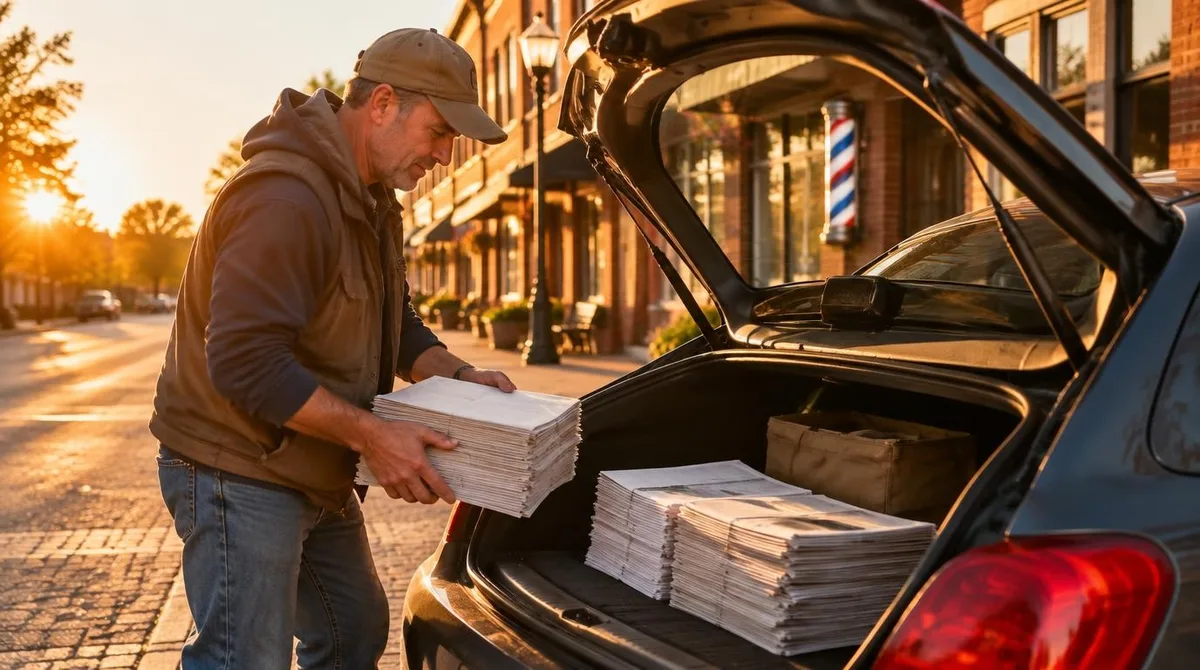
The free ad paper in your mailbox is not a relic. It is a business that still pays its bills, week after week, in towns where the daily paper has thinned out or disappeared. It survives because it does one thing well: it puts a store's name and a coupon in front of people who live close enough to actually walk in.
It is also free to you, which is the whole trick. The reader pays nothing. Local businesses pay for the ads, and the paper's costs stay low — thin stock, simple layouts, a route driver instead of a newsroom. That lean structure is why these guides outlasted bigger, fancier publications.
What is a shoppers' guide, exactly?
Most towns have one, even if nobody calls it that. It is the weekly or biweekly tabloid filled with grocery circulars, hardware store ads, garage sale listings, and a calendar of local events. Some are standalone publications. Others are the advertising inserts of a small community paper. The name on the masthead matters less than the job it does: it is a directory of what is for sale within a short drive.
The economics are simple. A store pays a small amount — often modest compared to metro daily rates — to reach a defined set of households. The publication prints cheap and distributes free. Nobody subscribes, so nobody cancels. The whole model runs on volume and repetition, not on scoops or features.
Where did the classified money go?
The biggest hit to these publications came from classified ads moving online. For decades, classifieds were the profit engine of local print. When people started selling furniture and announcing yard sales on the internet, that revenue left the page.
You can see where it went by looking at any free classifieds site. The Albany page on craigslist, for instance, sorts everything a local ad paper once carried — antiques, appliances, furniture, garage sales, free items, even lost pets — into self-service categories, alongside community event calendars and a plain warning to readers to avoid scams and fraud. A business that once needed a print sales rep and a weekly deadline now posts in minutes, for little or nothing.
That shift did not kill the ad paper, though. It pushed it back to what it does best: display advertising from brick-and-mortar stores that want their flyer literally in the house, not buried in a feed.
How they make it work now
The survivors share a few habits. They keep overhead brutally low — often a handful of staff, sales reps who also write copy, and printing contracted out. They sell packages rather than single ads: a grocery chain buys the back page all year, a hardware store takes a quarter-page every week. Repetition is the product. Shoppers see the same store name fifty times a year and stop thinking about where to buy a hose.
They have also added digital without abandoning print. Many now run the same circulars as web editions and email blasts, and some sell the print-plus-online bundle to advertisers. The print run stays because it reaches people the internet misses — older residents, households that do not scroll local feeds, newcomers who have not yet found the town's Facebook groups.
Local news aggregation has changed the surrounding landscape, too. Aggregator sites now bundle community coverage from many outlets into one feed; the NewsBreak page for Albany, NY, for example, gathers items from partner publishers such as Times Union and WNYT NewsChannel 13 alongside smaller websites. That kind of feed competes for attention, but it does not put a grocery coupon on a kitchen counter — which is the ad paper's home field.
What this means for you as a shopper
Our analysis: the circular is quietly one of the better deal-finding tools left, precisely because nobody markets it. Grocery loss leaders, seasonal clearance, and store anniversary sales still show up there first. A few practical steps:
- Check the paper the day it lands. Circular prices are usually tied to a dated sale window, and the good ones sell out early.
- Read the fine print on any coupon — limits, dates, and whether it stacks with store loyalty pricing.
- Use the garage sale and free listings for the kind of secondhand finds that never make it to online marketplaces, because the sellers are often not online at all.
- Watch the event calendar. Sidewalk sales, craft fairs, and end-of-season market days are announced there weeks ahead.
The same skepticism you bring to any ad applies. A circular is advertising, not journalism. The prices are real, but the framing — "lowest prices of the season" — is written by the store. Compare against the national chains' apps before you drive anywhere.
Why the model keeps working
Ad papers survive for the same reason small-town downtowns do: proximity. A national retailer can undercut a local store on price, but it cannot put a flyer on the counter of the diner where the owner eats lunch. The circular is the print version of that relationship — cheap, local, and repeated until it sticks. Readers following this should also see The Best Small-Town Downtowns for a Day of Shopping — and How to Tell a Real One From a Set.
That is also why the format tracks the health of local retail. When chains close stores, as we have covered in our reporting on store closures in 2026 and the uneven year for malls across the country, the ad pages feel it in canceled insertions. When independent shops open, the paper is often the first place they advertise, because it is the cheapest way to reach the neighborhood. This connects to our earlier piece, Store Closures in 2026: The Chains Cutting Locations and What It Means for Shoppers.
The honest caveat is the one the industry itself would give you: the number of these publications keeps shrinking, and consolidation continues. But "shrinking" is not "gone." In thousands of towns, the weekly guide still lands on Wednesday or Thursday, the grocery ads still anchor the back page, and the model — free to read, paid by the store two miles away — still covers its costs. For shoppers willing to spend ten minutes with it, it remains one of the last free tools that tells you what is for sale near you, this week, at a price you can verify by driving over and looking.